There's one more potential cause of erosion, however... subsurface water coming through the house foundation! Kinda scary, but apparently rainwater from the front yard runs underneath the driveway slab, flowing under the foundation grade beam, creating rivulets in the crawl space, pushing out again into the backyard, then runs under another small concrete walk, finally trickling onto this muddy path, as seen in the photo foreground. Relatively mild, but I'll definitely have to create a solution soon.
Dec 31, 2005
Reduced erosion
So far so good after the recent storms. This area used to get a lot of surface runoff, becoming a river of erosion after each rain. Now it looks controlled. The trench drain system seems to be working well. Fast heavy water entering the trench gets carried to the back without losing a drop. Slow water too, gladly. Knock on wood. Newest tree (Brisbane box) is visible at the top center of photo, and surviving okay.

There's one more potential cause of erosion, however... subsurface water coming through the house foundation! Kinda scary, but apparently rainwater from the front yard runs underneath the driveway slab, flowing under the foundation grade beam, creating rivulets in the crawl space, pushing out again into the backyard, then runs under another small concrete walk, finally trickling onto this muddy path, as seen in the photo foreground. Relatively mild, but I'll definitely have to create a solution soon.
Dec 11, 2005
Brisbane box
Lophostemon confertus(formerly Tristania confertus)
An evergreen tree to 30-50 feet in height with an equal spread. Upright growth habit when young, broadens with age, clusters of white 3/4 inch flowers bloom in summer. Produces woody fruit capsules. Red-brown bark peals to show lighter colored bark. Tolerates most any soil. Needs little to no summer water when established. Best in full sun, but will tolerate some shade. Prune branch tips when young for a full, well branched tree. No inspect or disease problems. Good street or lawn tree. Keep lower leaves for one or more seasons when young to provide extra growth energy.
5-gallon from East Bay Nursery $40
Nov 22, 2005
Surround sound
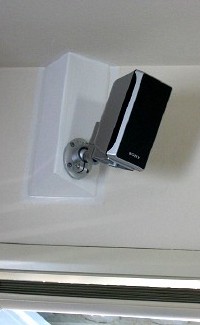
HDTV is not complete without Dolby Digital. It has to be at least a 5.1 system (five speakers + one subwoofer). Good thing I installed a bunch of 16-gauge speaker wires in the wall and attic during the closet removal on the other side. For the two rears I first thought of flush in-ceiling speakers. But that would require a custom system, and aiming the sound would still be questionable. My office in-wall speakers sound great, but the walls here are exterior -- there's insulation and a header beam to deal with.So I decided to get a bundled system (sometimes referred to as HTIB or Home Theater In a Box) with wall-mountable satellites. I got the same make as the TV, which allows use of just one remote. I made triangular boxes so that simple wall-mounting brackets could be used, aiming was more versatile, and wiring easily routed from the ceiling. For its shape and size I had to consider the future window trim and crown moulding. I think it looks okay.
HDTV has to be experienced to be appreciated. There are many levels of quality. Digital is all-or-nothing. There's never poor picture (displays vary, but that's a different matter) -- if the signal is weak there's just no picture at all. Not all digital is HD. Not all HD takes advantage of rear speakers. Not all DVD players can upconvert to near-HD resolution. And proper HDMI and optical cabling becomes noticeable. But once everything is in place, the results are truly amazing.
Now Monday Night Football crowds scream from behind.

Check HD programming in your area.
Nov 21, 2005
Antenna grounding
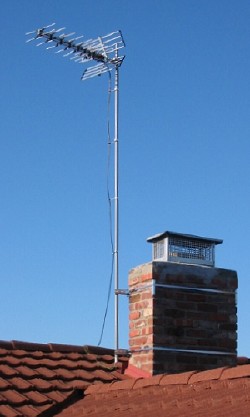
Of course, electrical grounding is important for any metal object sticking up on a roof. I soldered a 14 gauge copper wire to the mast, threading it into the attic just like I did with the signal cable, then soldered again to a copper plumbing pipe. A little spray paint makes it look amazingly professional!Notice my roof covering is metal tile (it only looks like clay tile from a distance). I wonder what effect it'll have during a lightning strike...
Antenna
HDTV is digital, which means broadcast reception can be as good as cable or satellite. So far, it actually seems better. You obviously don't get a hundred channels. But with all the major stations broadcasting in digital, over-the-air reception easily trumps a basic subscription like Comcast's $14/month. It's free afterall. It only requires an ASTC tuner (either built-in or, in the case of HDTV-ready sets, separately purchased).According to antennaweb.org, the main direction for 14 of the 15 primary digital signals in my area is about 187 to 194 degrees in compass orientation. They're mostly 21.7 and 25.5 miles away, so a medium-range directional UHF antenna is what I needed. NBC is the only station on VHF, which it won't get. I figure I can give up watching NBC.
I got the 42XG from AntennasDirect.com for $59. Important is also a RG6 coaxial cable to minimize signal loss. I found a roof vent nearby to get it into the attic. From there it goes directly into an interior wall, then comes out through a grommet wallplate to the TV without any additional connection. The mast, chimney mount and cable standoffs are from Radio Shack.
It's also a good idea to check USGS topo maps like topozone.com. There's actually a 360-foot (altitude) hill about 7 miles in the same direction -- while I'm at 180 feet with about 40 feet up to antenna. Apparently it's no problem.
Subscribe to:
Posts (Atom)